
ABOUT
Marzipan Physics is the pseudonym of Jennifer Ross (b. 1972, London, England). She is a visual artist based in New York City. She received her BA in 1994 from Yale University and has exhibited her work in group shows throughout New York City , at galleries including :iidrr Gallery, One Art Space, Con Artist, Lazy Susan Gallery, Lucas Lucas Gallery,. Superchief, Queens Arts Collective, 3rd Ethos Gallery, and venues including Five Points Festival, Theater for the New City, Bowery Poetry Club, .and The William Vale Hotel , as well as Gallerie Iham in Paris, France.
Ross’ work has been written about in publications including Up Magazine, Sold Magazine, and Bushwick Daily.
Her long career as a UX/Visual Designer, which spans the infancy of the web to the present day, informs her art practice.
ARTIST STATEMENT
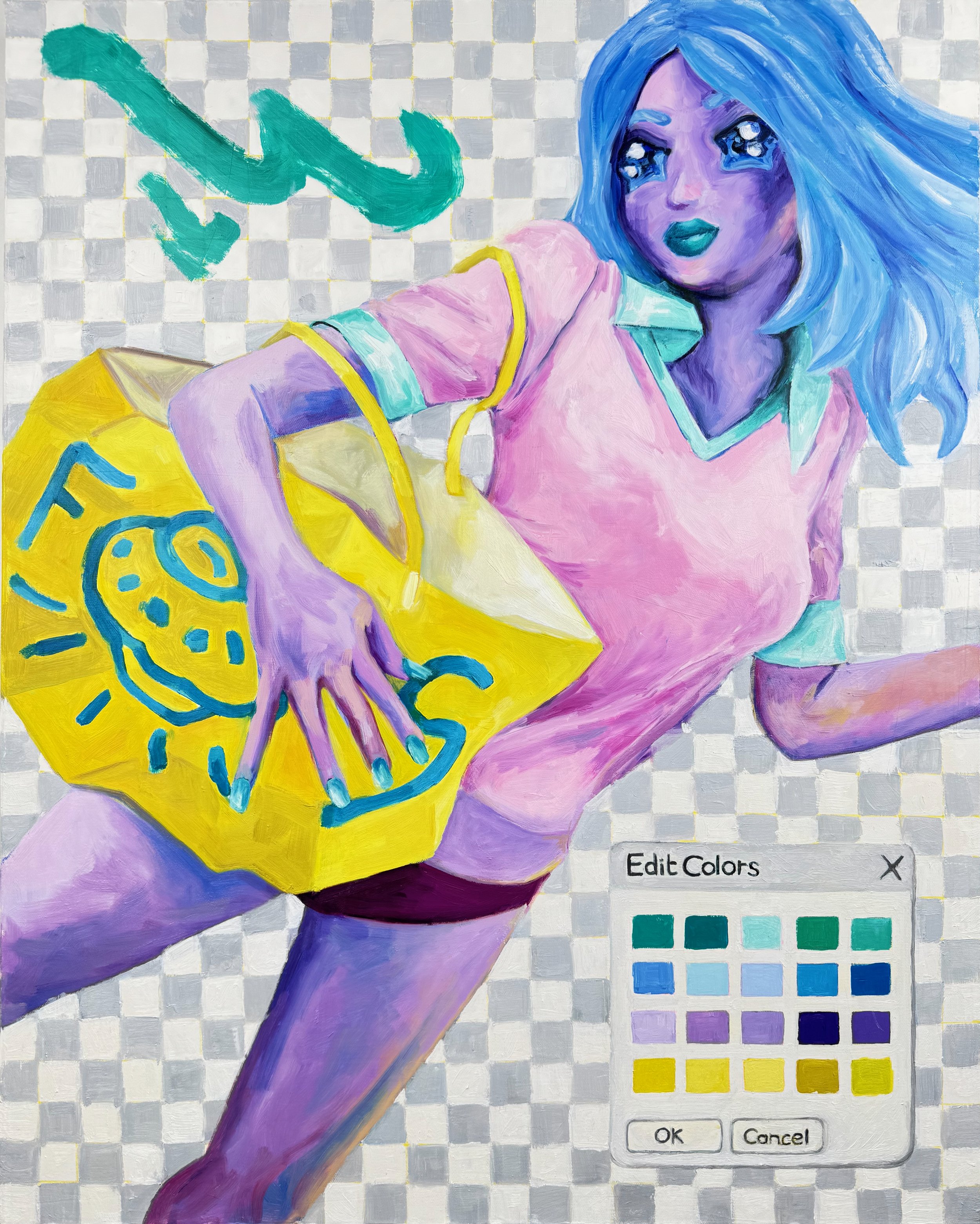
Marzipan Physics is the pseudonym of American artist Jennifer Ross, whose paintings are populated by candy-colored extraterrestrial characters from a zany sci-fi universe. Layered with elements from screen interfaces and video games, with poses appropriated from luxury handbag ads, social media, and classical paintings, they explore the relationship between human consciousness and technology, the role of narratives and world-building in how we process reality, and the creative fruits of ongoing cross-cultural conversations.
Rendered with oil paint in an expressive, painterly style using a vivid pastel palette, her unapologetically girly figures, with star-shaped eyes and Pynchonesque names, serve as a playful rejoinder to the common dismissal of all things deemed feminine, in art as well as society at large. Inspired in equal parts by Japanese animé and European post-impressionism, the paintings reflect Ross’ interest in how encountering different ways of seeing has caused cultures to evolve creatively.
The interface-design elements in the compositions, as well as the rendering of certain forms in a “low-poly” style that evokes Cubism, both reveal an important part of her process—the creation of the reference images via 3D modeling software—and reflect the inescapable nature of human-digital interaction, and the impact that it has on our lives. The work is informed by her long career as a User Experience Designer, which sensitized her to the problematic nature of app-mediated existence, and ultimately led her to find the antidote in the materiality of oil painting on canvas. Her chosen medium also creates an unexpected juxtaposition of hyper-current subject matter with traditional practices, suggesting a form of time-travel, which she hopes can provide the viewer with moments of clarity.
Balancing out her somewhat sardonic takes on our current tech-industrial complex is her belief in the positive changes that are possible when people work together on technologies in the public interest, which can be seen in her paintings and storylines about particle colliders and nuclear fusion.
Text-based narratives and digital art can be found in the MarzipanWiki, an ever-evolving online repository which serves as a companion to the physical works. Here, the curious viewer can learn more about the characters and world of the MPU (Marzipan Physics Universe) and see the digital images that inspired the paintings. While either can be experienced without the other, the paintings and the Wiki enhance each other, with the back and forth reflecting the dance between physical and digital that we experience constantly.